 atareh
Research & Op-ed · MAR 15, 2026
Anthropic's new data on AI and jobs: what it means for tech workers
A breakdown of Anthropic's March 2026 report on AI labor displacement. No mass unemployment yet, but hiring of young workers into exposed roles is already slowing down.
The short version
Anthropic published a report on March 5, 2026, introducing a new way to measure whether AI is actually displacing workers. They call it "observed exposure" — it combines what LLMs could theoretically do with what people are actually using them for, weighted toward automated (not just assisted) work tasks.
The headline result: no clear rise in unemployment for AI-exposed workers yet. But there's one red flag — hiring of 22-25 year olds into exposed occupations has slowed by about 14% since ChatGPT launched.
What they actually measured
Most AI labor studies use a theoretical score — "could an LLM do this task?" Anthropic went further. They combined three data sources:
- The O*NET database of ~800 US occupations and their specific tasks
- Real Claude usage data from the Anthropic Economic Index — what tasks people actually use Claude for
- Theoretical exposure ratings from Eloundou et al. (2023) — whether an LLM could make a task 2x faster
The distinction matters. A lot of tasks that AI could handle haven't been automated yet. Legal restrictions, software requirements, verification steps, and plain old organizational inertia all slow things down. 97% of actual Claude usage falls on tasks already rated as theoretically feasible — so the models aren't being used for unexpected things. They're just not being used for everything they could be used for.
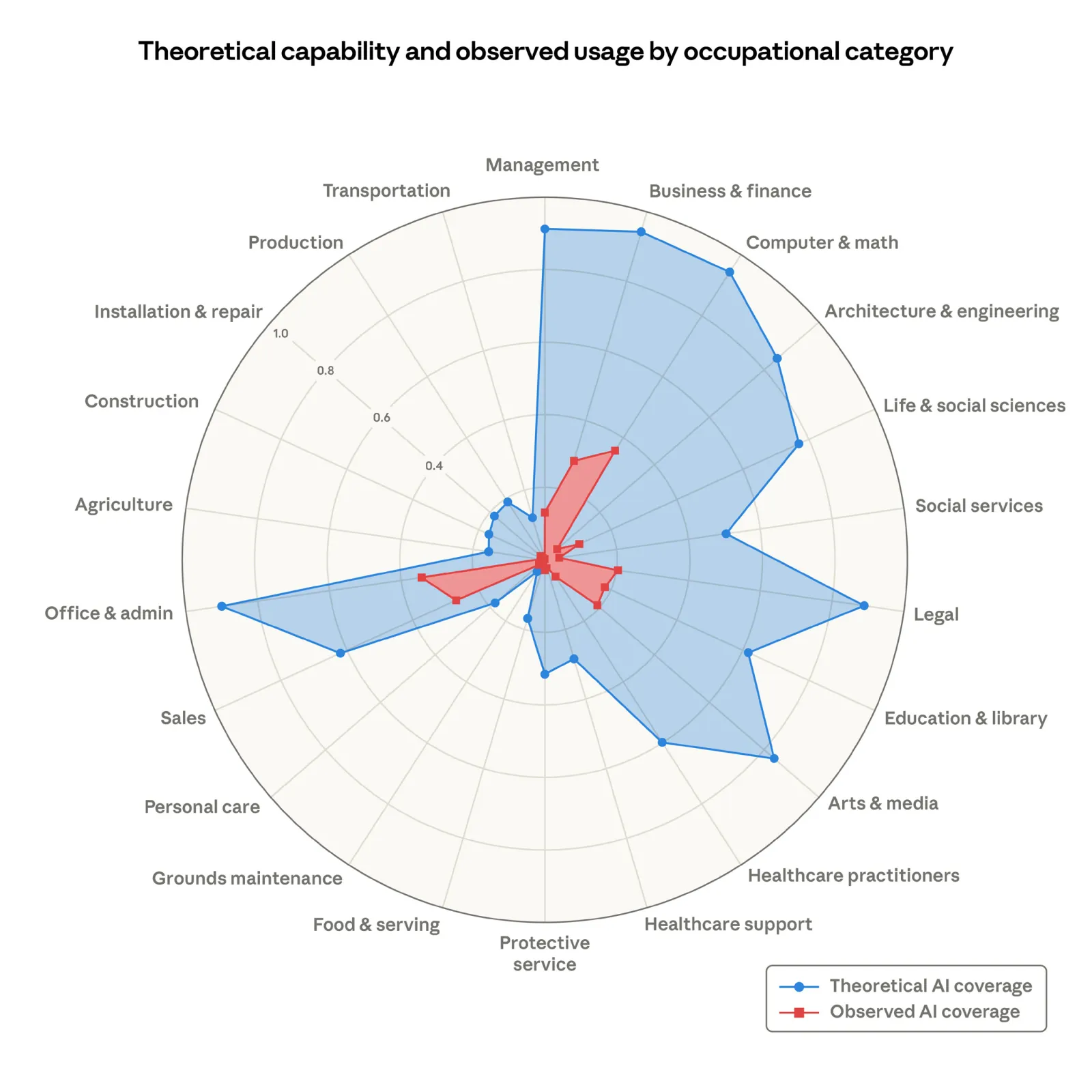
Theoretical capability (blue) vs. actual observed exposure (red) by occupation category. The gap between them shows how far real-world adoption lags behind what's technically possible.
Key findings
The report's core question: are workers in AI-exposed occupations losing their jobs at higher rates than everyone else?
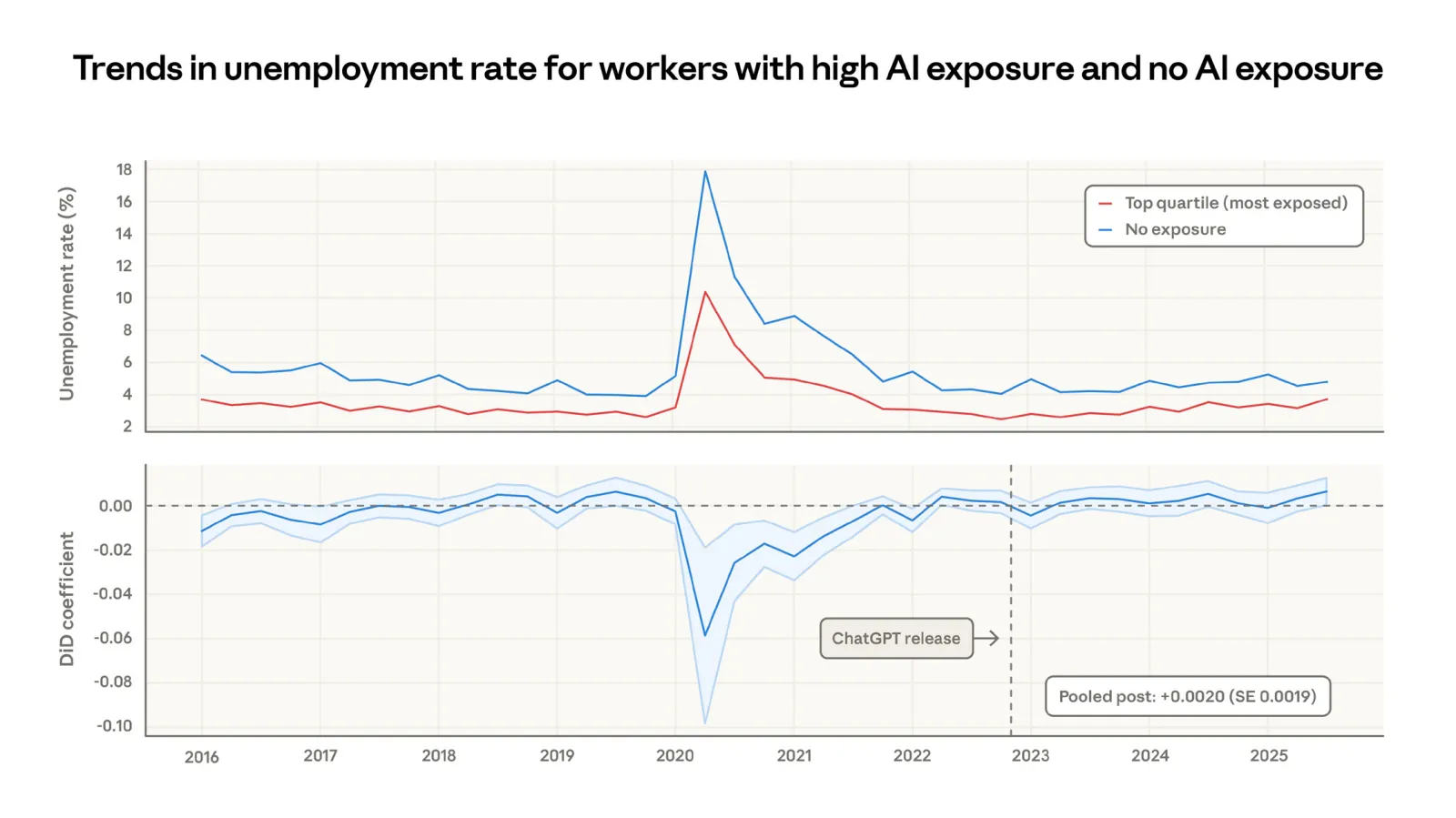
The answer, so far, is no. The unemployment rate gap between the most-exposed and least-exposed workers hasn't changed in any statistically meaningful way since late 2022. The authors note that a "Great Recession for white-collar workers" — unemployment doubling in exposed occupations — would show up clearly in their framework. Nothing like that is happening.
Unemployment rate for workers in the top quartile of AI exposure (red) vs. workers with zero exposure. The trends track closely — no visible divergence after ChatGPT's release.
But here's what's worth paying attention to: the BLS projects that jobs with higher observed exposure will grow less through 2034. For every 10 percentage point increase in AI coverage, the projected growth rate drops by 0.6 percentage points. Not catastrophic, but directionally clear.
Who's most exposed
The top three most-exposed occupations:
- Computer Programmers — 75% task coverage
- Customer Service Representatives — driven by first-party API traffic (think chatbots)
- Data Entry Keyers — 67% coverage, primarily document reading and data input
At the other end, 30% of workers have zero observed coverage. Cooks, motorcycle mechanics, lifeguards, bartenders, dishwashers — jobs that involve physical presence, manual dexterity, or real-time human judgment in unpredictable environments.
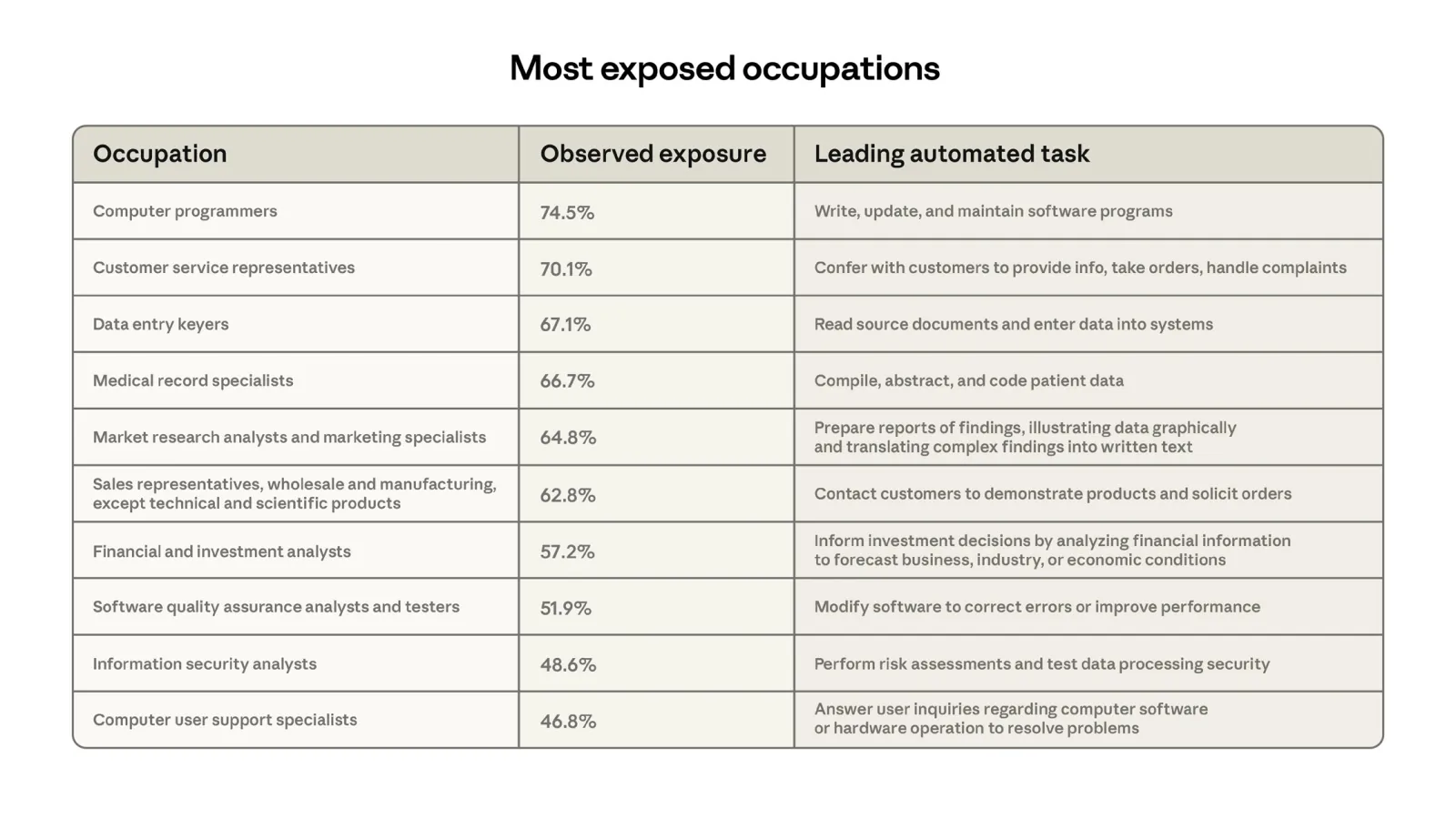
Top 10 most exposed occupations ranked by observed task coverage.
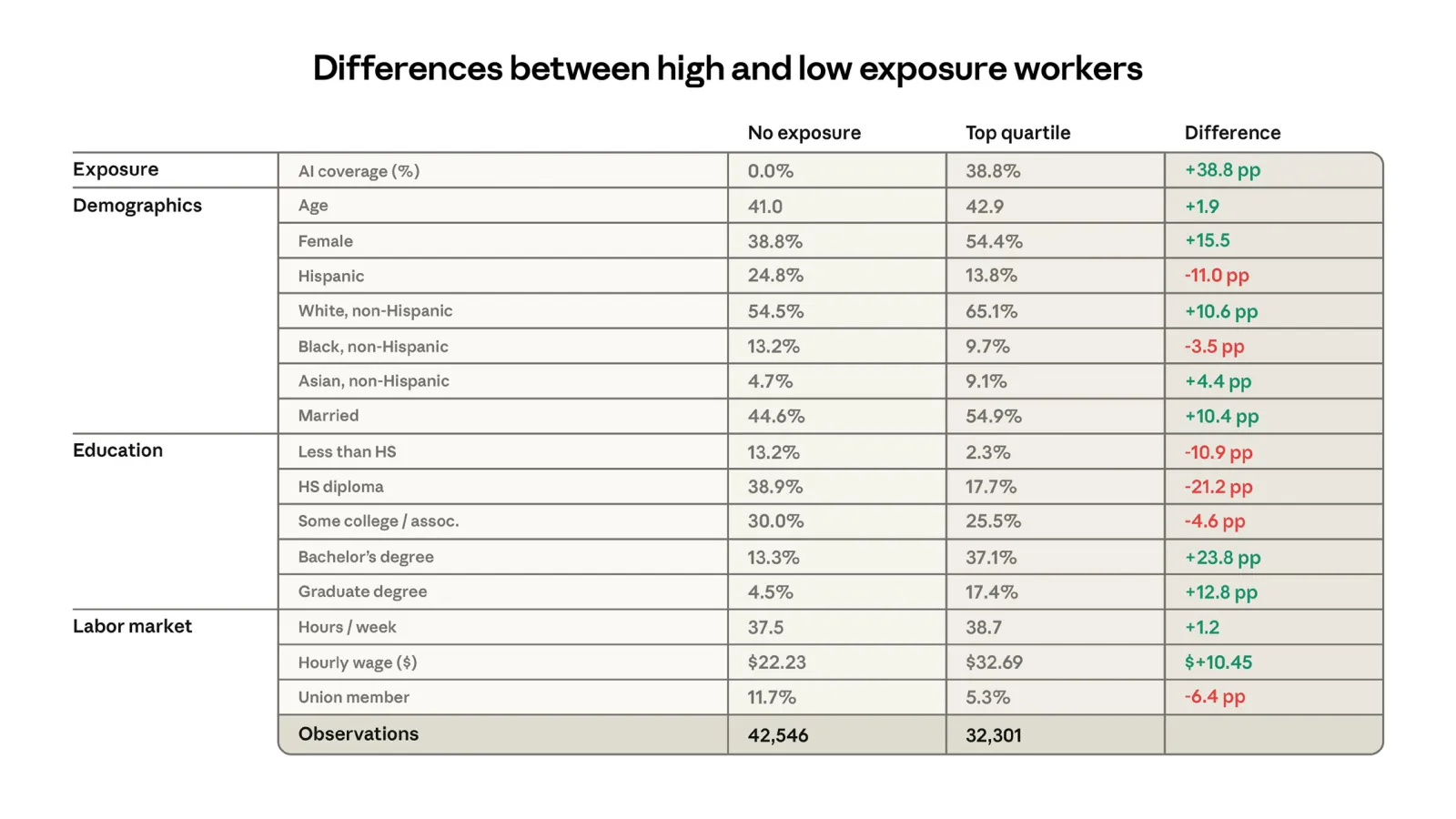
The demographics of the exposed group are distinct: compared to unexposed workers, they're 16 percentage points more likely to be female, 11 points more likely to be white, almost twice as likely to be Asian, and they earn 47% more on average. People with graduate degrees make up 17.4% of the most exposed group vs. 4.5% of the unexposed group.
The young worker problem
This is where the report gets uncomfortable. While overall unemployment in exposed occupations hasn't budged, hiring of 22-25 year olds into those same occupations has dropped. Job-finding rates for young workers entering exposed occupations fell by about half a percentage point, while entry into less-exposed jobs stayed flat.
New job starts among 22-25 year olds. Entry into high-exposure occupations (red) visually diverges from low-exposure (blue) starting in 2024.
The averaged estimate is a 14% drop in the job finding rate for exposed occupations compared to 2022 levels. The result is barely statistically significant, and the authors flag several alternative explanations — young workers could be staying at existing jobs longer, switching to different roles, or going back to school. But it lines up with findings from other researchers (Brynjolfsson et al.) who saw a 6-16% employment drop for this age group in exposed occupations.
Worth noting: this effect doesn't appear for workers older than 25.
What this means if you work in tech
Computer programmers top the exposure list at 75% task coverage. If you write code for a living, that number should be in the back of your mind. But here's the context that matters:
You're not getting fired because of AI — yet. The unemployment data is clear on this. The people losing their jobs right now aren't losing them to LLMs at any measurable rate. But "not getting fired" and "your job looks the same in five years" are two different statements.
The entry-level pipeline is narrowing. If you're a senior engineer, the immediate threat is low. If you're 23 and trying to break into tech, the numbers suggest companies are already hiring fewer people into roles where AI handles a big chunk of the work. The question isn't whether your job disappears — it's whether the next version of your job gets created at the same rate.
The gap between "could automate" and "has automated" is your runway. Only 33% of Computer & Math tasks have actual AI coverage, against 94% theoretical capability. That gap will close. The speed at which it closes depends on tooling, compliance, organizational willingness, and whether the models get good enough to handle the messy parts — not just the clean, well-defined tasks.
Augmentation still dominates automation. The report weights automated use more heavily, but most Claude usage is still augmentative — people using it to work faster, not replacing themselves. The workers who treat AI as a multiplier on their existing skills are better positioned than those who ignore it or those whose roles consist entirely of tasks AI can automate end-to-end.
The BLS agrees with the trend line. Their independent projections show weaker growth for exposed occupations through 2034. These analysts don't have access to Claude usage data — they arrived at similar conclusions through their own labor market models. When two independent methodologies point the same direction, it's worth taking seriously.
Read the full report
This post covers the highlights. The full 24-page report by Maxim Massenkoff and Peter McCrory (published March 5, 2026) includes the mathematical framework, appendix with robustness checks, and the complete reference list.
Labor market impacts of AI: A new measure and early evidence
Massenkoff, M. & McCrory, P. (2026). Published by Anthropic.
Download PDF →Written by
@atareh
AI architect & creator. Writing, designing, and producing in AI and tech. Previously head of product at a healthtech SaaS; background in molecular science. Founded gogray.today in 2017.
Related
Keep reading.
Made by @atareh · x / twitter · instagram